Why Most Cybersecurity Tools Fail — And What Military Doctrine Taught Us About Fixing It
On April 9, 1917, four Canadian divisions did something no army had managed in over two years. They captured Vimy Ridge.
The British had tried. The French had tried. Both suffered catastrophic losses. The position seemed impossible to take.
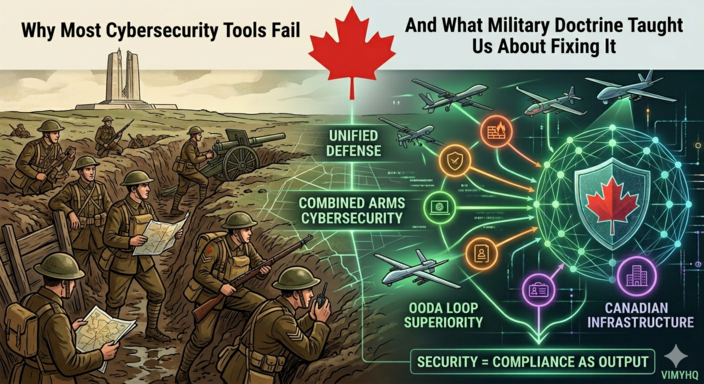
The Canadians didn't succeed because they had better soldiers or better weapons. They succeeded because they changed the doctrine. Instead of sending infantry forward in isolated waves, they coordinated artillery, infantry, tunnelers, and aerial reconnaissance into a single unified operation. Every unit knew the full plan. Every soldier carried a map. When one element was suppressed, the others adapted in real time.
Military historians call this combined arms warfare. It was revolutionary in 1917. And it's exactly what cybersecurity has been missing for the last twenty years.
We named our company after that battle because the principle behind the victory is the same principle behind our platform. That's not marketing — it's architecture.
The single-tool problem
Most companies approach cybersecurity the way armies fought before Vimy. One tool per problem. One vendor per threat.
You buy an endpoint protection product. It watches your laptops. You buy a firewall. It watches your network perimeter. You buy an identity provider. It handles login security. Maybe you add a compliance tool to generate audit reports.
Each tool operates in its own silo. Each vendor gives you a dashboard. Each dashboard shows you a slice of reality. None of them talk to each other in any meaningful way.
This is how breaches happen. Not because any single tool failed, but because attackers operate across boundaries that your tools don't share. A phishing email lands in an inbox — that's the email layer. A credential gets stolen — that's the identity layer. The attacker uses that credential to access cloud infrastructure — that's a different tool entirely. By the time anyone connects the dots, the attacker has moved through three defensive layers that were never designed to communicate.
This is the cybersecurity equivalent of sending infantry forward without artillery support. Each unit is competent on its own. Together, they're uncoordinated. And uncoordinated defense loses to coordinated offense every time.
What military doctrine gets right
Modern military doctrine solved this problem decades ago. The concepts aren't complicated, but applying them to cybersecurity requires rethinking the entire architecture.
Combined arms means that no single defensive capability operates alone. When a threat is detected at one layer, every relevant layer responds simultaneously. The attacker can't defend against coordinated pressure from multiple directions at once. A response that blocks a suspicious IP at the perimeter while simultaneously revoking the compromised credential and isolating the affected server isn't three separate actions — it's one coordinated operation.
Defense in depth means that breaching one layer doesn't give you access to everything behind it. Each layer is designed so that if it falls, the next layer is already prepared. More importantly, the breach itself is shaped to the defender's advantage. When an attacker pushes through the perimeter, they should land in a space where the defender has better visibility, not less.
OODA superiority is about speed. Observe, Orient, Decide, Act — and do it faster than the adversary. The attacker has an OODA loop. If the defender can detect, analyze, decide, and respond before the attacker completes their next move, the attacker loses the initiative. Most security operations centers measure response time in hours or days. Attackers measure their operations in minutes.
Battle damage assessment means that after you respond to a threat, you don't assume the response worked. You verify. You check whether the attacker adapted. You confirm containment. Most security tools execute a response action and move on. They never ask "did that actually work?"
These aren't abstract concepts. They're engineering requirements. And they demand a fundamentally different architecture than the one most cybersecurity vendors sell.
Why nobody has built this before
The cybersecurity industry is structured around point solutions. Each vendor owns a layer. Endpoint companies build endpoint tools. Network companies build network tools. Identity companies build identity tools. Compliance companies build checkbox platforms.
The reason is economic, not technical. It's easier to build and sell a product that does one thing well. It's easier to market "the best endpoint protection" than to explain a unified defense architecture. Investors understand single-product companies with clear competitive positioning.
But the customer — the company getting attacked — doesn't experience security in layers. They experience it as one problem. "Are we protected?" is a single question that currently requires stitching together six different vendor dashboards to answer. And the answer is usually "probably, but we have gaps we can't see."
The gaps between tools are where attackers live. The cybersecurity industry has spent two decades optimizing individual layers while leaving the spaces between them largely undefended.
A different architecture
We built VimyHQ on a different premise. Instead of starting with a single layer and expanding outward, we started with the doctrine and worked backward into the technology.
The platform is designed around defensive positions we call batteries — a deliberate military term. Each battery covers a specific domain: perimeter, identity, infrastructure, and more as the platform expands. But unlike point solutions, every battery shares a common operating picture.
When a threat is detected at any layer, the system doesn't just alert you. It correlates that signal against every other layer. A suspicious login attempt isn't evaluated in isolation — it's evaluated in the context of what's happening at the perimeter, what's changing in the infrastructure, and what the baseline behavior looks like for that entity. This is what combined arms looks like in practice.
The response isn't a single action either. When the platform determines a threat is real, it generates a coordinated response across multiple layers simultaneously — the same way a military operation coordinates fire from multiple positions. The attacker faces pressure from every direction at once.
And every detection, every response, every verification generates compliance evidence automatically. SOC 2 controls, PIPEDA requirements, ISO 27001 mappings — they're not a separate workstream. They're a byproduct of actual security operations. You don't do compliance and then do security. You do security and compliance falls out the other side.
What this means for Canadian companies
Canadian companies face a specific version of this problem. Most security and compliance tools on the market are built by American companies, for American companies, hosted on American infrastructure.
When you're trying to demonstrate compliance with PIPEDA, Law 25, or provincial privacy regulations, using a tool that stores your security data in Virginia creates an obvious contradiction. You're proving you protect data by sending that data across the border.
VimyHQ runs on 100% Canadian infrastructure. Every event, every detection, every compliance artifact stays in Canada. The AI engine that analyzes your security events runs on Canadian GPUs. There are no US subprocessors in the chain. This isn't a feature — it's a foundational design decision that affects every part of the architecture.
For companies selling to enterprise customers, pursuing SOC 2, or navigating Canadian privacy law, this distinction matters more every year.
Security that generates compliance
The traditional approach to compliance is backward. You hire a consultant. They give you a spreadsheet. You spend months filling it out. You collect evidence manually. You prepare for an audit. The audit happens. You get your report. Then you spend the next eleven months ignoring compliance until the cycle starts again.
This doesn't work because compliance isn't a project — it's a state. Either your controls are working today or they're not. A spreadsheet can't tell you that. Only active security monitoring can.
When your security platform is watching your identity layer, monitoring your perimeter, tracking your infrastructure, and correlating events across all of them in real time, compliance evidence isn't something you build — it's something you export. Your auditor doesn't get a spreadsheet. They get a living record of every control, every event, every response, with timestamps and evidence chains that prove your security program is operational every day of the year.
This is what we mean when we say compliance is a byproduct, not a project. The security operations are the engine. The compliance artifacts are the exhaust. You need both, but you only have to build one.
The name isn't an accident
We didn't name the company VimyHQ because it sounds good. We named it because the Battle of Vimy Ridge represents something specific: the moment when coordinated defense proved that preparation, communication, and combined arms could overcome a position that brute force couldn't take.
Every cybersecurity company tells you they'll protect you. We think the question is how — and the answer matters.
If your security tools don't talk to each other, you don't have a security program. You have a collection of products.
If your compliance is a once-a-year spreadsheet exercise, you don't have compliance. You have documentation of what was true last quarter.
If your data is sitting on foreign servers while you claim to protect Canadian privacy, there's a gap between your story and your architecture.
We built VimyHQ to close those gaps. Coordinated defense. Real-time operations. Compliance as output. Canadian infrastructure. No compromises.
If your enterprise customers are asking about SOC 2, or your insurance provider is tightening their requirements, or you're simply tired of stitching together six dashboards to answer one question — we should talk.
VimyHQ is a cybersecurity and compliance automation platform built on Canadian infrastructure. Defense that succeeds where others fail. Learn more · See our plans · Book a demo